Observations
Concepts
Miscellaneous
 a day. The path of the sun mapped on the celestial sphere is called the ecliptic. Obviously one can only figure this out paying a lot of attention to the stars and remembering what happens.
There are a number of somewhat obvious observations of the motion of the sun:
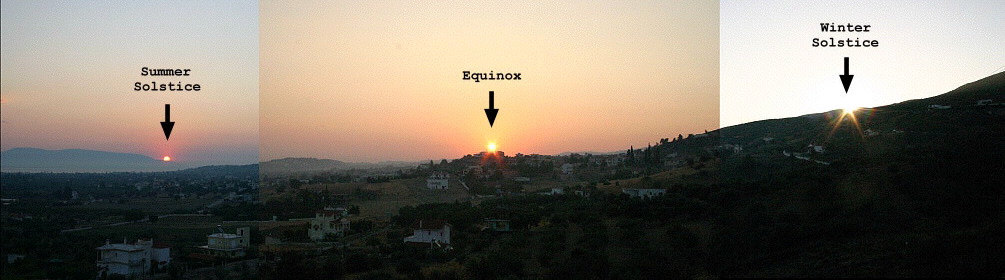
a day. The path of the sun mapped on the celestial sphere is called the ecliptic. Obviously one can only figure this out paying a lot of attention to the stars and remembering what happens.The picture below shows sunrises at the solstices and an equinox in a town in Greece. This is taken from NASA's Astronomy Picture of the Day. On the summer solstice, the sun will rise at its most northern position on the horizon, and at local noon, the sun will be the highest in the sky that it is all year.
The motion of the sun in the arctic or antarctic makes for awesone time-lapse video, and the internet provides all. YouTube has all sorts of videos of arctic (and antarctic) sunsets and things: the arctic during the summer and the winter solstice in Alaska. If the links failed, just search on north pole sun and you'll get lots of videos, along with posts from nutjobs who think the earth is flat, has holes in it and that NASA fakes everything. That's why I teach, I suppose.
To help visualize all this, there is an excellent sun motions demonstrator at the University of Nebraska - Lincoln.
There are a number of somewhat obvious observations of the motion of the moon.
along the celestial sphere each day.UNL also has a good lunar phase simulator.
While there are a number of obvious things going on with the stars, one has to pay attention becuase the changes are so gradual.
To help visualize the rotation of the celestial sphere, there is an excellent rotating sky explorere at the University of Nebraska - Lincoln. This just shows the effect of the rotation of the earth and doesn't include seasonal changes.
One has to pay attention to the stars to notice the planets. To the naked eye, they appear as bright stars. One also has to be very familiar with the stars and constellations to notice that there are 5 stars that are slowly moving. These are called the planets. The easily visible ones are Mercury, Venus, Mars, Jupiter and Saturn. (Mercury is actually tough to see - one has to get it just before dawn or just after sunset.) It turns out that Uranus is also visible to the naked eye, but it is very faint, moves very slowly and is very hard to notice.
wide.
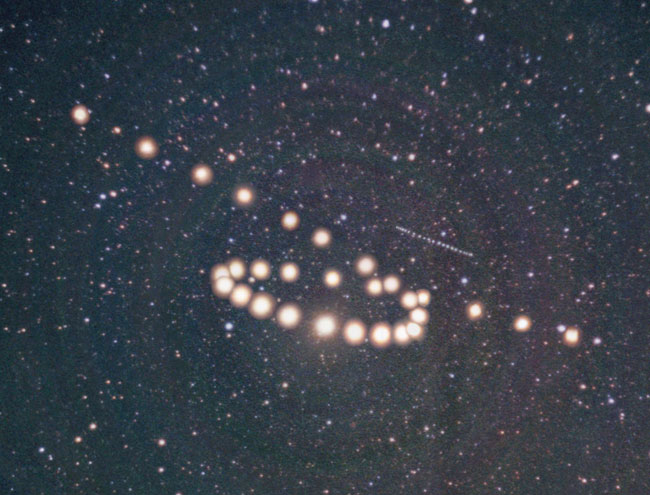
The picture below shows a series of pictures of Mars in retrograde motion. There are several days taken between each photo, and it nicely shows Mars do a loop-the-loop against the "fixed" stars. The little streak above Mars is actually Uranus. Photo taken from http://antwrp.gsfc.nasa.gov/apod/ap031216.html
Looking in the sky, there are a number of other things going on.
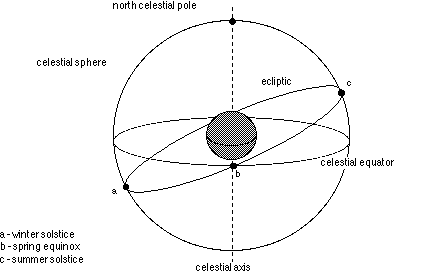
The picture below shows the key parts of the celestial sphere. We imagine a large sphere centered on the Earth that contains all the stars. The equator of the Earth projects out and is the equator of the celestial sphere, and the axis of the Earth's rotation is the axis of the celestial sphere. (The North Star happens to be pretty close to the North Celestial Pole.) The ecliptic is tilted 23.5 from the celestial equator. The two equinoxes are the times of the year when the sun crosses the celestial equator. (In the diagram, only one equinox is visible, marked "b.") The solstices are the two times that the sun is farthest from the celestial equator, marked "a' and "c" in the diagram. The Zodiac is the group of 12 constellations that are equally spaced around the ecliptic.
Links for More Information:
Nice summary of most of this information, with a lot of good diagrams: http://astro.wsu.edu/worthey/astro/html/lec-celestial-sph.html